
How to Manage Work-Life Balance Using Coworking Spaces

Boundaries blur quickly when work emails follow you to the couch or your mind is still at the office during family time. For freelancers and remote professionals in Amarillo, balancing personal life with flexible schedules can feel like a challenge worth solving. By focusing on your current routines and selecting the right coworking space, you can create a clear separation and enjoy genuine work-life balance that boosts productivity and wellbeing.
Quick Summary
| Key Message | Explanation |
|---|---|
| 1. Assess Your Current Boundaries | Track your work hours and interruptions to establish an objective baseline for your work-life balance. |
| 2. Choose a Supportive Workspace | Select a coworking space that enhances focus and ensures a clear separation between work and personal life. |
| 3. Customize Your Daily Routine | Define your work hours and plan transitions to reduce decision fatigue and maintain boundaries. |
| 4. Integrate Scheduled Breaks | Schedule true restorative breaks, prioritizing activities that genuinely help you recharge and refocus. |
| 5. Regularly Evaluate Your Plan | Review and tweak your routines monthly to sustain balance as your needs and circumstances evolve. |
Step 1: Assess your current work-life boundaries
Before you can improve your work-life balance, you need to understand where you stand right now. This step involves taking an honest look at how work currently bleeds into your personal time and how present you are in both spaces. You might work from your couch, check emails during dinner, or find your mind still processing work problems when you should be relaxing. The goal here is simple: get clear on what's actually happening in your daily routine so you can make intentional changes.
Start by asking yourself a few straightforward questions. When do you typically stop working each day, and do you actually stick to that time? How many times do work interruptions pull your attention away during off-hours? Are you mentally present when you're with family or friends, or is work constantly nagging at your brain? According to research on managing boundaries in flexible work environments, understanding your unique boundary preferences and recognizing how you currently handle off-hours interruptions is the foundation for real change. Think about your morning routine too. Do you wake up and immediately check work messages, or do you ease into your day? Pay attention to stress signals as well. If you feel constantly anxious, scattered, or unable to truly disconnect, those are clear indicators that your boundaries need work.
One practical way to visualize this is to map out your typical week. Note when you work, when you should be off-duty, and where those lines blur. You might use a simple calendar, a journal, or even just mental notes over a few days. The key is noticing patterns. Maybe you realize you work until 7 PM most nights, or you work most weekend mornings without thinking about it. These patterns show you where boundaries are either missing or too loose. This assessment isn't about judgment. It's about gathering real data so you can decide what actually matters to you and what needs to change.
Pro tip Take three days to simply observe your routine without trying to change anything yet. Write down your start and stop times, note interruptions, and track your mental presence. This raw data becomes your baseline for measuring progress once you establish your ideal boundaries.
Step 2: Select the ideal coworking workspace
Now that you understand your current boundaries, it's time to find a workspace that actually supports them. The right coworking space does more than provide a desk and internet. It actively enables you to disconnect from home distractions, maintain professional separation between your work and personal life, and create the mental space you need to focus. Union Hall offers exactly this kind of environment right here in Amarillo, with flexible options that let you work your way without being locked into rigid leases or hidden fees.
When evaluating a coworking space, pay attention to what matters most for your boundaries and wellbeing. Consider the physical environment first. Is it quiet enough for focused work, or does the buzz of activity distract you? Does it have spaces where you can actually take a real break, away from your desk? Look at the amenities and services available. Union Hall provides 24/7 access so you work on your schedule, plus conference rooms for professional meetings, high-speed internet that won't fail you, and a ground-level parking setup that removes logistical stress. Research shows that coworking spaces reduce employee loneliness by providing a third venue distinct from home and office, which actually improves emotional health and job performance. But here's what matters most for your boundaries: can you actually leave work behind when you're done? Some spaces feel like extensions of the home setup you're trying to escape. Look for a location with clear separation, a professional atmosphere that signals "this is work time," and a community culture that respects personal time.
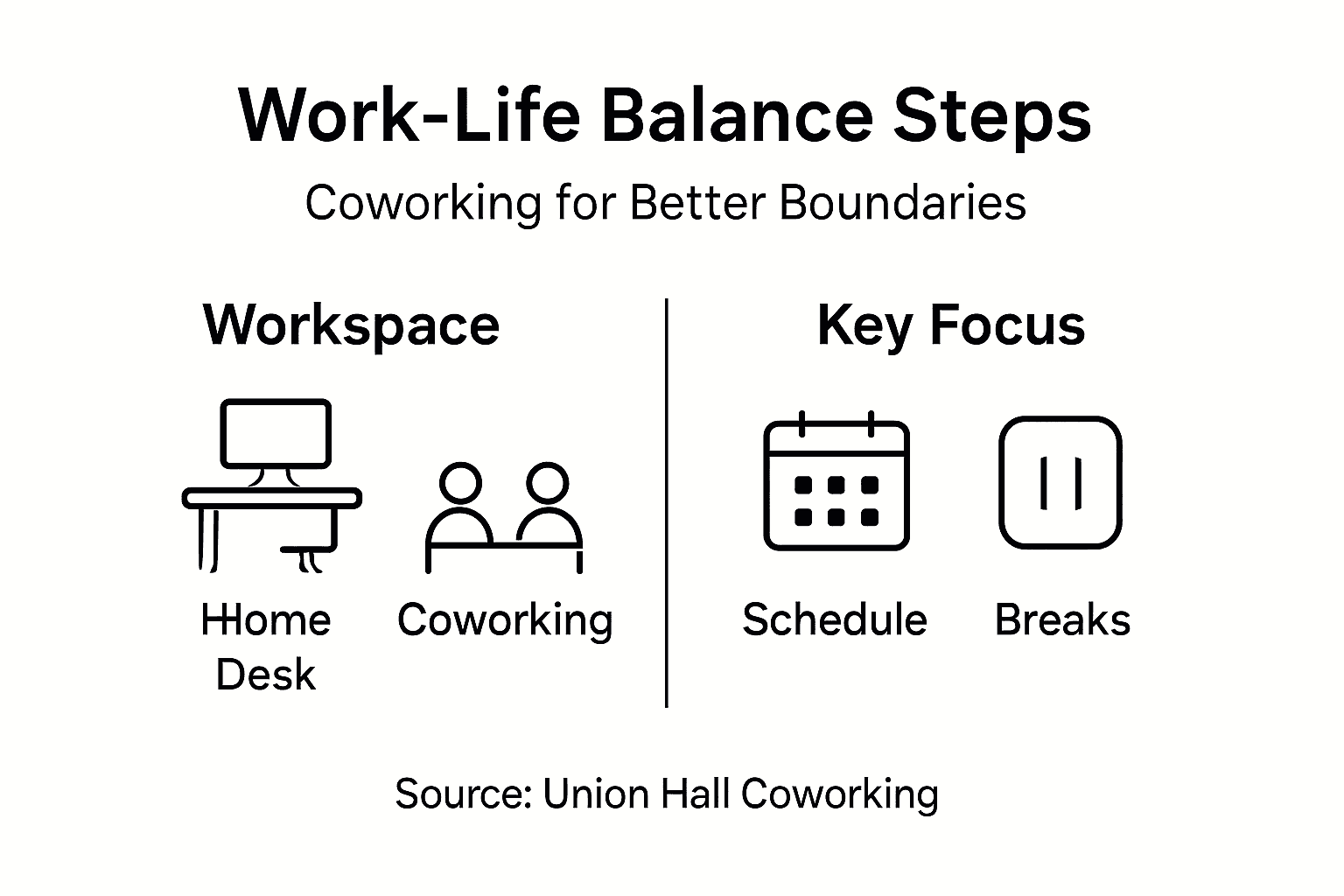
Visit potential spaces in person if you can. Spend 15 or 30 minutes working there before committing. Does the noise level work for you? Can you focus without constant interruptions? Do the other members seem to respect quiet hours? Pay attention to the vibe. A space that supports your wellbeing will feel calming rather than chaotic, professional rather than like another home office. Think about practical factors too. Is the location convenient for your routine, or will commuting feel like a burden? Does membership pricing align with what you're willing to spend? Union Hall memberships start at $99 per month for open workspace, with dedicated desks and private offices available, all with straightforward pricing and no surprise fees. The goal is finding a space where boundaries feel natural because the environment itself supports them.
Compare how home offices and coworking spaces impact work-life boundaries:
| Factor | Home Office | Coworking Space |
|---|---|---|
| Boundary Clarity | Lines often blurred | Distinct separation by location |
| Distraction Risk | High (family/chores nearby) | Lower (dedicated work zone) |
| Social Interaction | Limited or isolated | Built-in professional community |
| End-of-day Ritual | Hard to establish | Physical departure signals closure |
Pro tip Schedule a trial day or week at any space you're seriously considering. Work your normal hours, take your breaks there, and notice how you feel when you actually leave at the end of the day. That genuine experience reveals more than any tour ever could.
Step 3: Establish a customized daily routine
A structured routine is your secret weapon for maintaining work-life boundaries. Without one, your days blur together and you end up working whenever inspiration strikes, which usually means all the time. A customized routine anchors your day, gives you permission to stop working, and signals to your brain when it's time to shift gears. The beauty of using a coworking space is that your commute becomes a natural bookend to your workday, making it easier to build these boundaries into your routine.

Start by defining your ideal work schedule. Are you a morning person who thrives on an early start, or do you need time to ease into the day? When do you do your best work, and when do you hit the afternoon slump? Build your routine around these realities, not against them. According to research on structured daily routines, consistency matters more than perfection, and your routine should be adaptable enough to handle real life while regimented enough to keep you focused. Think about when you'll arrive at Union Hall, what your first task will be, when you'll take breaks, and when you'll leave. The routine doesn't need to be rigid. It needs to be intentional. Maybe you arrive at 8 AM, spend the first 30 minutes on email and planning, tackle your most important work from 9 to 12, take a proper lunch break away from your desk, then handle administrative tasks in the afternoon. Build in buffer time for meetings, unexpected issues, or simply things taking longer than expected. The key is knowing roughly what each block of time is for, which reduces decision fatigue and keeps you on track.
Next, think about the transitions between work and the rest of your life. What signals the end of your workday? Maybe it's closing your laptop at a specific time, taking a walk around the Amarillo area, or having a consistent ritual before you leave the building. These transitions matter because they tell your nervous system that work is over. Without them, you carry work stress into your evening and sleep poorly, which tanks your productivity the next day. Plan for occasional disruptions too. Some days will require flexibility, and that's okay. The routine isn't meant to be a prison. It's meant to be your default when life cooperates, so you're not constantly making decisions about when to work. Start with your core hours this week. Write them down. Try it for five days and notice what works and what feels forced. Then adjust. Your ideal routine will emerge from this experimentation, not from trying to follow someone else's schedule.
Pro tip Block your entire workday in your calendar as a single appointment with yourself, then add specific focus blocks within it. This prevents others from scheduling over your work time and gives you visual clarity on how your day is actually structured.
Step 4: Integrate breaks and personal time effectively
Breaks are not luxuries or signs of laziness. They are essential maintenance for your brain and body, and they directly impact your ability to maintain healthy work-life boundaries. Without intentional breaks, you burn out, your focus deteriorates, and suddenly you cannot stop working because stopping feels impossible. When you work at Union Hall, you have the physical space to truly step away from your desk, which makes breaks feel legitimate and restorative rather than stolen moments of guilt.
Start by scheduling breaks the same way you schedule meetings. Treat them as non-negotiable appointments. Research on strategic break-taking at work shows that regular breaks improve focus, energy, and overall performance by reducing stress and enhancing mental clarity. The key is choosing breaks that actually rest your brain. If you spend all day staring at screens, then take a break and stare at your phone, you have not actually rested. Real breaks mean stepping outside, taking a short walk, stretching, grabbing water, or doing something completely different from your work tasks. Union Hall members benefit from having dedicated break spaces and easy access to movement. You could walk around the building, step outside to the Amarillo area, or use the common areas to change your environment. Aim for at least one 15-minute break every two hours and a proper lunch break of 30 to 60 minutes away from your workspace. Your brain needs this rotation between intense focus and genuine rest to maintain productivity.
Next, build personal time into your day before it gets squeezed out. This is not time left over at the end of the day. This is time you protect intentionally. Personal time might mean leaving at exactly 5 PM to exercise, blocking Friday afternoons for personal appointments, or protecting your lunch hour so you actually eat and recharge. The difference between good work-life balance and burnout often comes down to whether you defend your personal time or treat it as something that happens if work permits. When you use a coworking space, your commute and the physical act of leaving becomes a natural transition that signals personal time is starting. Use that signal. Do not sit in your car checking work emails. Do not immediately shift to household tasks. Actually transition. This mental shift, supported by your physical separation from the workspace, is what makes the difference. Track how you spend your breaks and personal time for a week. Notice what genuinely restores you and what feels obligatory. Then double down on what actually works.
Pro tip Set a phone timer for the end of your workday and when it goes off, close your laptop immediately. No finishing one more email. The psychological shift of a hard stop is more powerful than you think and trains your brain to respect your boundaries.
Step 5: Evaluate and adjust your work-life balance plan
Your work-life balance is not something you set once and forget. It requires regular evaluation to see what is actually working and what needs to change. Life shifts, work demands fluctuate, and your needs evolve. A plan that worked perfectly three months ago might feel off now. This step is about building a sustainable feedback loop so you can stay balanced instead of waiting until burnout forces you to make changes.
Start by taking inventory every four to six weeks. Look back at your boundaries, routine, and breaks. Are you actually sticking to the schedule you created, or has it slowly eroded? How is your stress level compared to when you started? Are you sleeping better? Do you feel more present with family and friends? According to research on work-life balance evaluation and adjustments, regularly assessing your personal values, daily routines, and mental engagement across different life domains helps identify what is working and what needs improvement. Ask yourself honest questions. What one thing is draining your energy most right now? Is it a specific time of day, a particular type of work, or the way you are managing interruptions? What one improvement would make the biggest difference in your wellbeing this month? Notice patterns. Maybe you realize you are leaving Union Hall later than planned on Tuesdays and Thursdays because of client calls. Or perhaps you are checking work email during dinner three times a week without noticing. These patterns show you where your plan needs adjustment, not where you are failing.
When you identify what needs to change, make one adjustment at a time. If you try to fix everything at once, nothing sticks. Maybe this week you commit to leaving by 5 PM every day, or you move your lunch break to noon so it actually feels like a real break. Next month you might work on turning off notifications after 6 PM. Small, intentional changes compound over time far better than dramatic overhauls that you cannot maintain. Union Hall supports this flexibility. Your membership adapts to your needs, whether you need more space during busy seasons or less during slower periods. Use that flexibility as part of your adjustment process. Track what you change and notice the impact. After two weeks, evaluate. Is this working? Do you feel better? If yes, keep it. If no, try something different. This iterative approach keeps your plan realistic and sustainable long-term.
Pro tip Schedule a 15-minute monthly review on your calendar the same way you would any important meeting. Set a reminder, sit with your notes, and honestly assess what is working and what needs to shift. Consistency in reviewing beats perfection in planning every time.
Here's a summary of strategies for building and maintaining work-life boundaries:
| Step | Main Focus | Key Action | Long-Term Benefit |
|---|---|---|---|
| Assess boundaries | Identify current habits | Track work hours & interruptions | Establish objective baseline |
| Choose workspace | Select supportive environment | Evaluate amenities and atmosphere | Improve focus & separation |
| Customize routine | Structure your workday | Define hours, plan transitions | Reduce decision fatigue |
| Integrate breaks | Schedule true downtime | Prioritize restorative activities | Prevent burnout, boost energy |
| Evaluate & adjust | Monitor and refine regularly | Review and tweak routines monthly | Sustain balance as needs change |
Find Your Perfect Work-Life Balance with Union Hall Coworking Spaces
Struggling to separate your work from home life While many remote professionals face blurred boundaries the article highlights key pain points such as constant interruptions lack of clear work routines and ineffective breaks that lead to burnout Union Hall understands these challenges and offers tailored workspace solutions designed to support your well-being and productivity Our 24/7 coworking membership options provide a distinct professional environment that helps you establish clear boundaries and reclaim your personal time
With flexible memberships starting at $99/month plus options for dedicated desks and private offices Union Hall equips you with enterprise-grade WiFi free conference rooms unlimited printing and virtual mail services—all with no hidden fees Our space fosters focus and community so you can build intentional routines take restorative breaks and leave work behind when the day ends Explore how investing in a reliable workspace removes distractions from coffee shops or home offices and helps create natural boundaries that boost your energy and satisfaction Learn more about our flexible membership plans and amenities at Union Hall and see why Amarillo’s remote professionals trust us to "Work. Your way. Right here in Amarillo."
Ready to build better work-life boundaries Start your journey today with a trial or membership at Union Hall Coworking where your ideal workspace supports your goals Schedule a visit and experience firsthand how the right environment transforms your routine and restores your balance
Want a workspace that makes boundaries easier to keep? Join Union Hall here: https://unionhalltx.com/membership
Frequently Asked Questions
How can coworking spaces improve my work-life balance?
Coworking spaces provide a dedicated work environment that separates professional tasks from personal life, helping you maintain clear boundaries. To leverage this, choose a coworking location that fosters focus and encourages you to disconnect when your work hours are over.
What should I look for when selecting a coworking space to support my work-life balance?
Focus on features that promote productivity and comfort, such as a quiet atmosphere, break areas, and flexible access hours. Visit potential spaces to personally evaluate them and ensure they align with your needs for a balanced work-life.
How can I establish a routine that promotes work-life balance in a coworking space?
Set a structured daily schedule that includes defined work hours, specific tasks, and regular breaks. Try committing to a routine for one week to identify what works best for you and make adjustments as necessary.
What types of breaks should I take during my workday to maintain my productivity?
Incorporate breaks that truly refresh you, such as short walks, stretching, or stepping outside for fresh air. Schedule a 15-minute break every two hours to recharge your mind and body, which can greatly enhance your focus when you return to work.
How often should I evaluate my work-life balance plan?
Regularly assess your work-life balance every four to six weeks to see what is effective and what needs adjustment. Make it a habit to sit down and review your boundaries and routines monthly to maintain a sustainable balance over time.
What techniques can I use to ensure I truly disconnect from work after my hours?
Implement clear end-of-day rituals, such as closing your laptop at a set time or taking a walk to signify the end of your work. By creating physical and mental rituals, you signal to yourself that work is done, helping to reinforce your boundaries.
Recommended
- How to thrive at a coworking space? — Union Hall Workspace
- How can working at a shared workspace benefit your business? — Union Hall Workspace
- Why Join Coworking Communities: Productivity and Connection — Union Hall Workspace
- Collaborative Workspace: Boosting Team Productivity — Union Hall Workspace
- What Is Work-Life Balance? Guide for Modern Leaders 2025 | Gammatica