
Outgrowing Your Home Office in Amarillo: When It’s Time
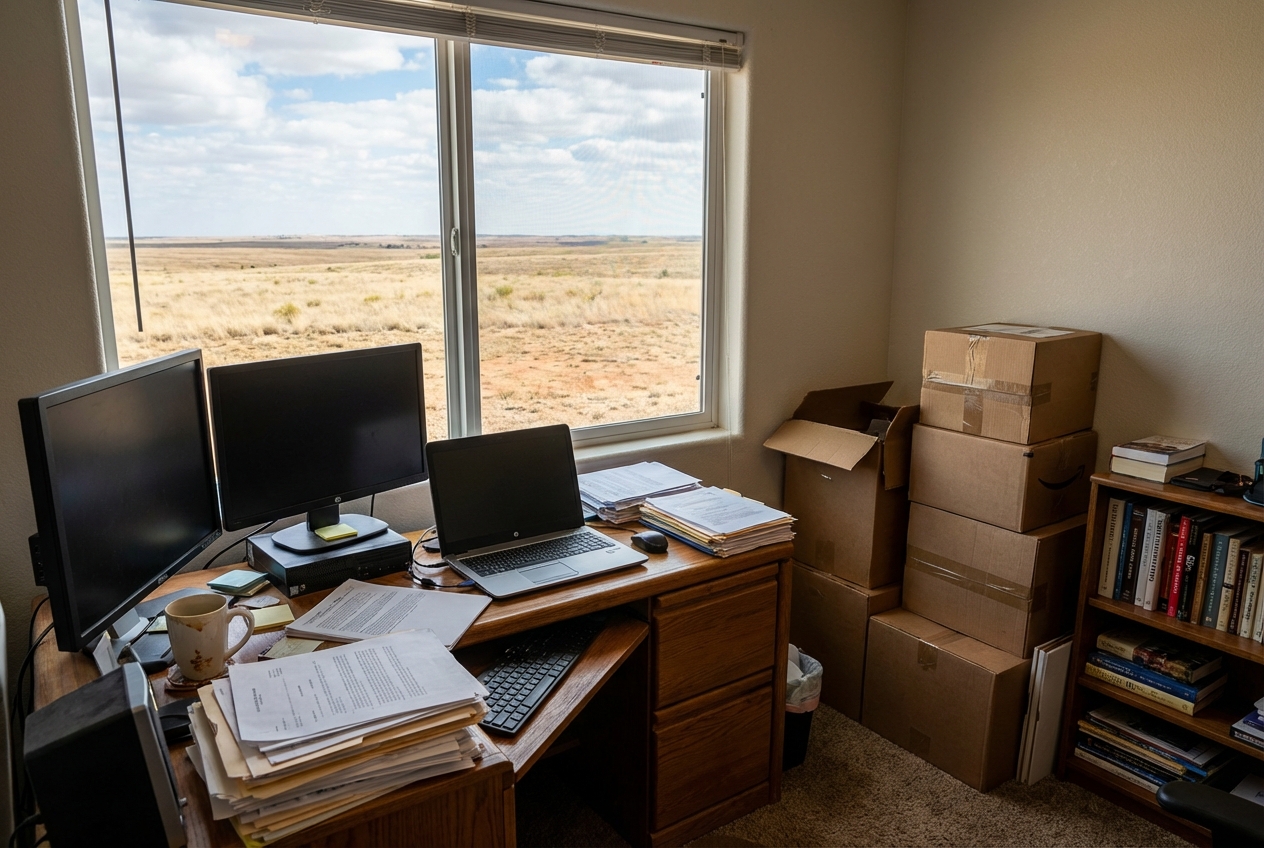
The stack of client files on your kitchen table has officially invaded the breakfast nook. Your spouse shoots you that look every time a Zoom call runs long during dinner prep. And yesterday, your toddler wandered into frame during a pitch presentation, clutching a half-eaten banana. Sound familiar?
You started your business at home because it made sense: low overhead, flexible hours, and no commute. But somewhere between landing your tenth client and hiring your first contractor, the walls started closing in. Your home office in Amarillo served you well, but the signs are everywhere that you've outgrown it.
Recognizing when it's time to transition from your spare bedroom to a professional workspace isn't about admitting defeat. It's about acknowledging growth. Amarillo's economy is thriving, with 1,428 jobs added in the past year alone, and your business deserves to be part of that momentum. The question isn't whether you'll eventually need a dedicated workspace outside your home. The question is whether you're already there.
Let's look at the concrete milestones that signal you're ready for this shift, and how to make it happen without locking yourself into a commitment that doesn't match your business reality.
Revenue and Hiring Milestones
The most reliable indicator that you've outgrown your home setup isn't frustration or clutter: it's money. When your revenue consistently exceeds $50,000 annually, or when you're bringing in enough to consider hiring help, your business has crossed a threshold that demands different infrastructure.
Think about what happens when you hire your first contractor or part-time employee. Where do they work? Having someone come to your house creates awkward dynamics and potential liability issues. You need a neutral space where professional relationships can develop without the weirdness of someone sitting in your living room. According to construction industry experts, employee overcrowding leads to tension and reduced productivity: and that tension multiplies when the "office" doubles as your family's home.
Revenue growth also brings complexity. You're managing more invoices, more client communications, more moving parts. The dining table that worked for a side hustle becomes a bottleneck when you're running a real operation. You find yourself shuffling papers, searching for documents, and losing track of critical details because your workspace wasn't designed for this volume.
Here's a practical benchmark: if you're spending more than two hours per week managing the logistics of your workspace rather than doing actual work, you're losing money. That time adds up to over 100 hours annually: time you could spend on billable work or business development.
Professional Credibility Signals
Your clients notice more than you think. That slightly echoey audio quality on calls? They hear it. The dog barking in the background during a contract negotiation? They remember it. The hesitation when they ask about visiting your office? They sense it.
Professional credibility isn't about impressing people with fancy digs. It's about removing friction from the sales process. When a potential client asks where you're located and you give them a legitimate business address instead of a residential street, something shifts in their perception. You become a business, not a person with a hobby.
This matters especially in Amarillo's growing market, where out-of-state investors are increasingly interested in the region's stability and opportunity. If you're serving clients who work with these investors or operate in professional services, your credibility signals need to match their expectations.
Consider the practical scenarios where a professional address and meeting space change everything:
- Client meetings that require confidentiality or formality
- Vendor negotiations where you need to project stability
- Partnership discussions with other businesses
- Interviews with potential hires who want to see where they'd work
- Any situation where you're asking someone to trust you with significant money or responsibility
At our Duniven Circle location, we've seen members close deals they'd been chasing for months, simply because they finally had a proper conference room to host the conversation.
Separating Work and Home Boundaries
The productivity research is clear: context matters. Your brain associates spaces with activities, and when your workspace is also your living space, those wires get crossed in ways that hurt both your work and your rest.
You've probably experienced this. You sit down at your home desk at 8 AM, and by 10 AM you've done a load of laundry, emptied the dishwasher, and answered three personal calls. Or the opposite: you're technically "off" for the evening, but your laptop sits there on the kitchen counter, silently judging you for not responding to that email.
Physical separation creates mental separation. When you leave a dedicated workspace and drive home, your brain receives a clear signal that the workday has ended. This isn't just about feeling better: it's about sustainable productivity. Burnout is real, and it often starts with the inability to truly disconnect.
Families feel this pressure too. Your partner didn't sign up to live in an office. Your kids don't understand why they can't make noise in their own house. The tension that builds from constantly negotiating these boundaries takes a toll on relationships that matter more than any client contract.
One of our members, Tabitha, described this shift perfectly: "I work mostly at home, but I love escaping to my Union Hall space when I need to really concentrate or when my internet at home is acting up." That option to escape: to have a place that's yours but not your home: changes everything about how you approach both work and family time.
Transitioning Without Signing a Long-Term Lease
Here's where many growing businesses get stuck. They recognize they've outgrown their home office, but the traditional options feel wrong. Commercial leases typically require multi-year commitments, substantial deposits, and responsibility for utilities, maintenance, and buildout costs. For a business that's still finding its footing, that level of commitment is terrifying: and rightfully so.
Amarillo's commercial real estate market offers some advantages, with average retail space running around $19.49 per square foot and a business-friendly environment that keeps costs below national averages. But even affordable leases come with strings attached that don't make sense for businesses in transition.
The smarter path involves flexible workspace solutions that scale with your actual needs. Start with what you need today: maybe that's just a dedicated desk and access to a conference room for client meetings. As your business grows, you can expand to a private office without renegotiating a lease or moving to a new location.
This flexibility matters because business growth isn't linear. You might land a big client next month that requires you to scale up quickly. Or you might lose one that forces you to scale back. A membership model that adjusts month-to-month protects you from both scenarios.
Consider what's included versus what's extra. Traditional office space often comes with hidden costs: internet setup, phone systems, furniture, cleaning services, coffee supplies, parking fees. These expenses add up quickly and make it hard to predict your actual monthly overhead. All-inclusive pricing removes that uncertainty.
At Union Hall, we've designed our membership structure around this reality. Private offices start at $400 monthly with just a four-month minimum: not a multi-year lease. That includes enterprise-grade WiFi, conference room access, unlimited printing, and ground-level parking. You know exactly what you're paying, and you're not locked into a commitment that outlasts your current business phase.
John, one of our members, found himself in exactly this situation: "I had a situation come up in the summer that caused me to find a last minute space. Union Hall set me up immediately with my own desk in a shared space, and had me in my own private office in a month. The rent terms are flexible and competitive."
The transition from home office to professional workspace doesn't have to be a leap of faith. It can be a measured step that matches your business reality.
Making Your Move
You already know whether you've outgrown your home office. The signs have been accumulating: the productivity struggles, the credibility gaps, the family tension, the sense that your business has outpaced its container. What's held you back isn't uncertainty about the problem. It's uncertainty about the solution.
The good news is that Amarillo offers options that didn't exist a decade ago. You don't have to choose between your kitchen table and a five-year commercial lease. Flexible workspace solutions let you upgrade your professional infrastructure while maintaining the agility that got you this far.
Ready to see what this transition could look like for your business? We'd love to show you around and help you find the right fit.
Book a free tour at Union Hall Workspace and get a complimentary day pass to experience the space firsthand. No pressure, no commitment: just a chance to see whether this is the next step your business needs.
Work from Union Hall Workspace in Amarillo
Coworking from $99/mo, dedicated desks $200/mo, and private offices from $400/mo. 24/7 access, month-to-month, no lease. See it in person with a free tour, or join online today.
Join or Book a Tour Compare Memberships